

Siroll® HPR rollers
Patented helical-profile rollers (Patent No. 20202200003711) for ceramic kilns
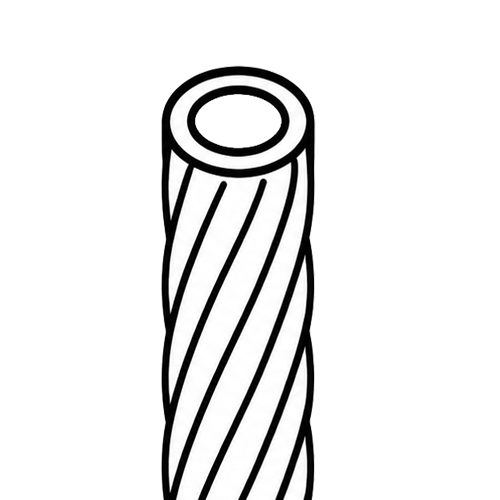
Siroll® HPR: multipurpose patented helical-profile rollers for ceramic kilns
Siroll® HPR is Sirtec’s patented helical roller. Developed on the basis of the LP 80 and new LP 80 Ti grades, both with an exceptionally high modulus of elasticity, it is designed for applications requiring high mechanical performance and stability under thermal variations.
The helical profile changes air dynamics inside the kiln channel, helping to create more uniform firing conditions and thereby counteracting the “roller effect”, black core, residue build-up on the rollers, and colour and shade deviations from the required result.
THE GRADE
Technical data for Siroll® HPR rollers
HPR rollers are based on the LP 80 and LP 80 Ti formulations, both characterised by an exceptionally high modulus of elasticity.
| Property | Siroll® HPR (LP 80 base) | Siroll® HPR (LP 80 Ti base) |
|---|---|---|
| Profile | helical, patented | helical, patented |
| Bulk density (kg/dm³) | 2.87 | 3.14 |
| Apparent porosity (%) | 13 | 9.5 |
| Water absorption (%) | 4.5 | 3 |
| Modulus of elasticity (GPa, 20 °C) | >120 | ≥145 |
| Thermal-shock resistance | very good | excellent |
| Identification colour | Green–Grey | |
| Intellectual property | Utility Model No. 202022000003711 Registered Community Design No. 015019706-0001/0003 | |
OPERATION
How the HPR helical profile works
The patented helical profile of the HPR roller (Patent No. 20202200003711) reduces the contact area between the roller and the tile and promotes air circulation above and below the conveying plane inside the kiln channel.
Its distinctive geometry, comprising a sequence of T-shaped profiles, gives the roller high rigidity and geometric stability. This helps maintain a straight conveying plane and consequently improves the flatness of tiles leaving the kiln.
The high modulus of elasticity and flexural strength of the LP 80 and LP 80 Ti base grades also help limit roller deformation under load, maintaining geometric stability in service.
HPR is a multipurpose roller designed for use throughout the kiln, from the entrance to the cooling zone. Its benefits vary according to the kiln zone and process conditions, but its geometry enables it to operate effectively in all the main kiln zones.
- Kiln entrance – reduces the build-up of press residue and engobe on roller surfaces;
- Entrance to initial firing zone – promotes degassing of the tile body, helping reduce the risk of black core and defects associated with rapid gas release;
- Firing to rapid-cooling transition – helps limit the “roller effect”, including shading and actual or barely perceptible deformation;
- Other kiln zones – promotes more uniform conveying and heat-transfer conditions, helping maintain consistent shade, flatness and calibre.
Thanks to its versatility, HPR can be used in every kiln zone, reducing the need for different roller types.
BENEFITS
Features and benefits
Every HPR feature delivers a process benefit that can be verified on the production line:
- LP 80 and LP 80 Ti base grades with a high modulus of elasticity (MoE >120 GPa)
- Patented helical profile (Patent No. 20202200003711)
- Improved degassing in the preheating zone
- Eliminates the roller effect
- Reduces rings and build-up
- More uniform temperature along the kiln channel
- Maintains the required shades and calibres
CERTIFIED TESTING
Testing and validation: a patented roller
HPR is protected intellectual property, not a marketing claim:
- Utility Model No. 202022000003711 – the helical-profile roller geometry is patented in Italy and worldwide.
- Proven use – HPR helical rollers are used by the world’s leading manufacturers of kilns and ceramic tiles.
LP 80/LP 80 Ti base grades and Sirtec’s data-driven approach: Sirtec has all its products tested by an independent ACCREDIA-accredited laboratory in accordance with EN 993-1:2018, ASTM E1876 and ISO 3187:1989.
Frequently asked questions about Siroll® HPR rollers
Is the HPR roller patented?
Yes. Siroll® HPR is protected by Utility Model No. 202022000003711 and Registered Community Design No. 015019706-0001/0003. It is the only helical-profile roller in the Siroll® range, and there are no known equivalent products offered by competitors.
How does it improve firing quality?
By moving air through the kiln channel, HPR helps even out temperatures and reduce shade and calibre deviations. In the preheating zone, it also promotes tile degassing, helping prevent black core. The fins on the helical profile also clean the roller by removing residue and deposits from its surface at the kiln entrance. Finally, at the transition from firing to rapid cooling, the helical profile helps counteract the “roller effect”.
In which kilns and production processes is HPR used?
HPR is used by leading manufacturers of kilns and ceramic tiles in the preheating and firing zones and at the transition to rapid cooling. It is recommended wherever uniform firing and reduced kiln downtime are required.